
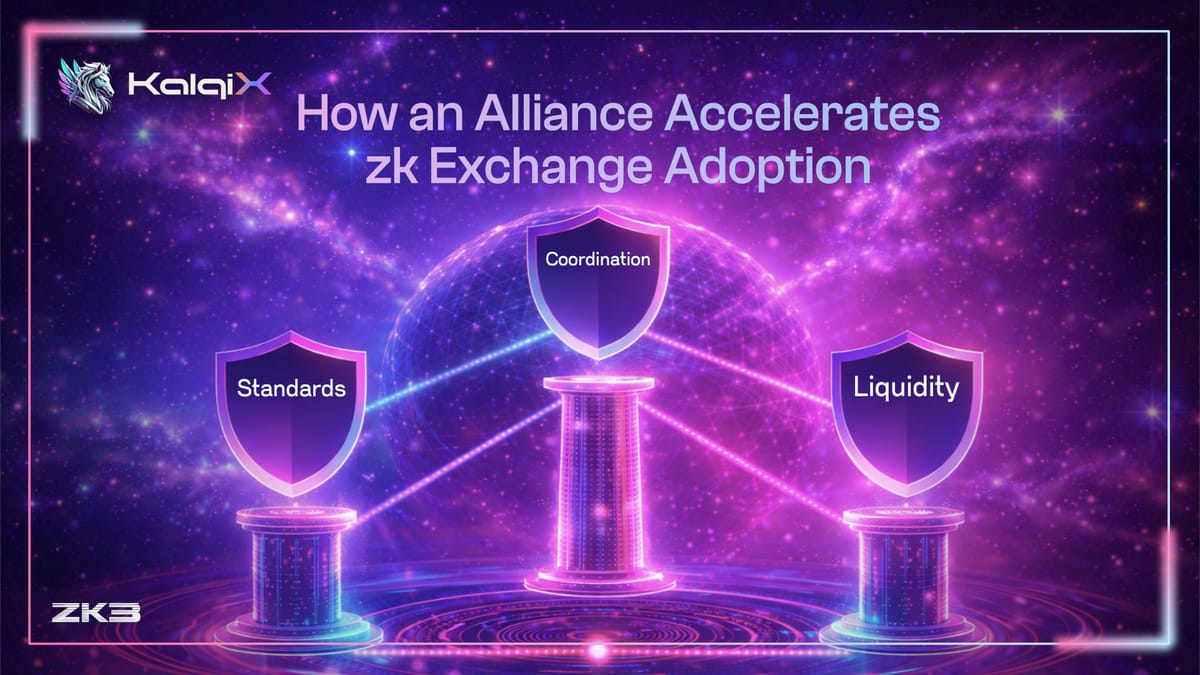
How an Alliance Accelerates zk Exchange Adoption

New infrastructure doesn’t win because it’s better.
It wins because it’s adopted.
Over the last decade, crypto has produced no shortage of technically superior systems that never reached critical mass—not due to flaws in design, but because adoption was fragmented, slow, and uncoordinated.
Zero-knowledge exchange infrastructure faces the same risk.
That’s why ZK-3 was never meant to scale alone.
And that’s why the ZK Trinity Alliance exists.
The Adoption Problem zk Infrastructure Faces
zk technology has matured rapidly—but exchange adoption has lagged behind.
Not because builders don’t believe in zk, but because:
• Building a zk exchange stack is expensive and complex
• Each team solves the same problems in isolation
• Integrations are bespoke and non-standard
• Liquidity fragments across incompatible systems
• Operators hesitate to bet their business on unproven stacks
The result is slow adoption—even for objectively better infrastructure.
Why Alliances Matter for Infrastructure
Infrastructure doesn’t scale like products.
Products compete.
Infrastructure coordinates.
Every major infrastructure standard—inside and outside crypto—scaled through some form of alliance:
• Shared APIs
• Reference implementations
• Common primitives
• Coordinated evolution
Without coordination, even the best systems splinter.
The ZK-Trinity Alliance exists to solve this exact problem for zk exchange infrastructure.
What the ZK-Trinity Alliance Changes
The alliance accelerates adoption by removing friction at every layer.
- Shared Standards Reduce Integration Risk
Instead of every operator asking:
“Will this stack still work in 12 months?”
The alliance provides:
• A shared execution standard
• Stable primitives
• Clear upgrade paths
• Responsible stewardship
This makes ZK-3 a safe long-term choice, not a speculative experiment.
- Builders Stop Reinventing the Same Primitives
Today, many teams independently build:
• Matching engines
• Settlement logic
• Proof systems
• Risk checks
The alliance allows builders to:
• Reuse battle-tested infrastructure
• Focus on differentiation
• Ship faster with higher confidence
Adoption accelerates when effort compounds instead of repeating.
- Operators Gain Credibility Through Collective Trust
Running an exchange isn’t just about code—it’s about trust.
The alliance creates:
• Shared credibility
• Collective validation
• Ecosystem-level confidence
For operators, this means:
“I’m not betting on a vendor—I’m joining a standard.”
That distinction matters.
- Liquidity Can Aggregate Instead of Fragment
Fragmented infrastructure fragments liquidity.
Shared infrastructure allows:
• Multiple venues
• Multiple frontends
• Shared execution guarantees
This creates deeper, healthier markets—without forcing everyone into a single product.
Adoption accelerates when users don’t have to choose between ecosystems.
- Governance Without Fragmentation
Open infrastructure without coordination leads to forks, incompatibility, and stagnation.
The alliance provides:
• Technical direction
• Backward compatibility
• Clear evolution paths
This ensures ZK-3 can evolve without breaking the ecosystem that depends on it.
Why This Matters Specifically for zk Exchanges
zk exchanges introduce new expectations:
• Verifiable execution
• Non-custodial guarantees
• Privacy without opacity
• Proof-based fairness
These guarantees only matter if they’re:
• Understood
• Standardized
• Widely adopted
The alliance accelerates that transition from “novel” to “normal.”
KalqiX and the Role of a Flagship
Every standard needs a reference implementation.
KalqiX serves that role for ZK-3:
• Proving the tech in production
• Stress-testing assumptions
• Validating performance at scale
But adoption doesn’t come from a single exchange.
It comes from many operators building with shared confidence.
That’s what the alliance enables.
From Early Adopters to a Global Standard
Adoption doesn’t happen all at once.
It happens in phases:
1. Early builders experiment
2. Operators seek reliability
3. Institutions demand guarantees
4. Standards emerge
The ZK-Trinity Alliance exists to guide ZK-3 through these phases—deliberately, responsibly, and without fragmentation.
Closing Thought
Technology alone doesn’t change markets.
Coordination does.
The ZK-Trinity Alliance is how zk exchange infrastructure moves from isolated deployments to a shared global standard.
This is how adoption accelerates.