
Launching Your Own Exchange with ZK-3: The White-Label Path Forward

For most teams, launching an exchange has always meant choosing between two bad options.
Either:
• Build everything in-house and spend years on infrastructure
or
• Rely on custodial or opaque systems that compromise trust and long-term viability
Neither path scales.
At KalqiX, we believe a third model is emerging — one where execution is standardized, trust is verifiable, and operators compete at the edge, not at the infrastructure layer.
That model is enabled by ZK-3.
The Operator’s Reality Today
Running an exchange is no longer just about UX or liquidity.
Operators today face:
• Rising custody and compliance risk
• Increasing scrutiny around execution fairness
• MEV and front-running concerns
• Long time-to-market for new venues
• High fixed costs for matching engines and settlement systems
At the same time, traders and liquidity providers expect:
• Non-custodial guarantees
• Predictable execution
• Privacy for large orders
• Institutional-grade performance
Meeting these expectations with custom infrastructure is no longer realistic for most teams.
Why Building Everything In-House No Longer Makes Sense
Exchange infrastructure has become too complex to rebuild repeatedly.
A modern exchange requires:
• A high-performance orderbook (CLOB)
• Deterministic and fair matching logic
• zk-based verification of execution
• MEV-resistant order handling
• Secure, non-custodial settlement
Each of these components is difficult on its own.
Together, they form a system that only a few teams can realistically maintain.
This is why the industry is shifting away from bespoke builds toward shared execution infrastructure.
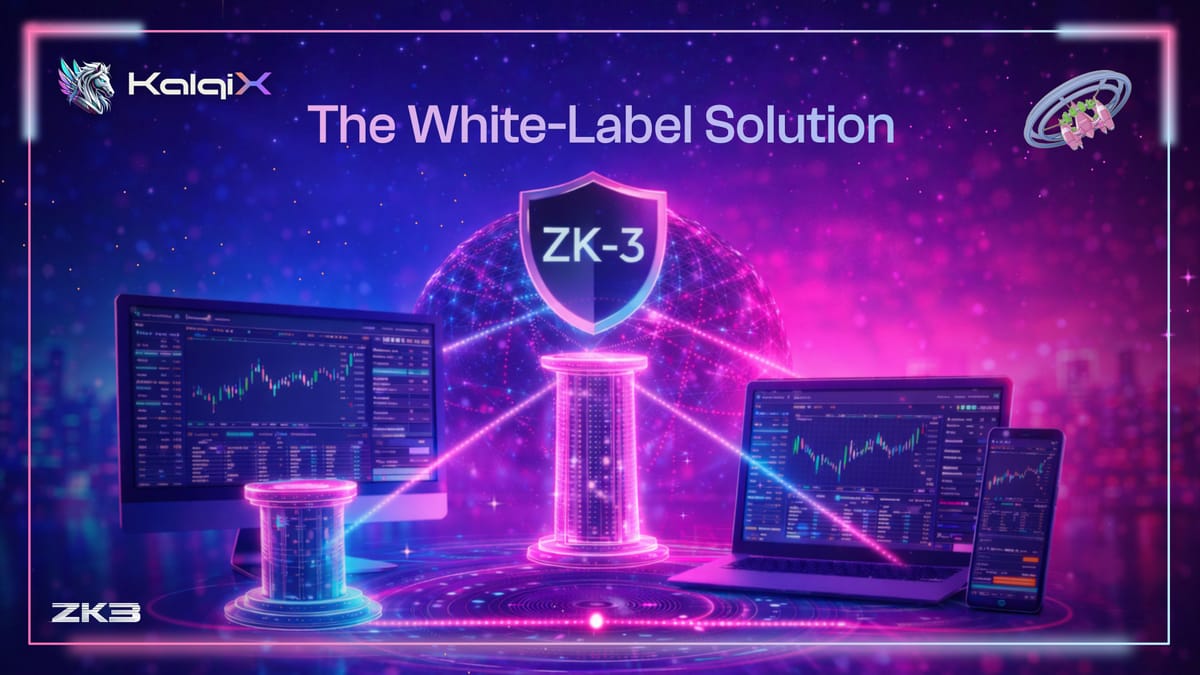
ZK-3 as a White-Label Exchange Stack
ZK-3 (ZK-Trinity) is a zero-knowledge exchange infrastructure built and owned by KalqiX.
Beyond powering the KalqiX Exchange, ZK-3 is designed to be white-label by default.
This means DEX teams, operators, and ecosystem players can launch their own exchange using ZK-3 technology, without building the execution layer from scratch.
What White-Label on ZK-3 Actually Means
White-label does not mean shallow theming.
Launching on ZK-3 allows operators to:
• Launch under their own brand
• Build and own their frontend and UX
• Select and manage their markets
• Cultivate their own community
• Operate a non-custodial exchange
While ZK-3 provides:
• A high-performance CLOB engine
• Private orderflow handling
• Verifiable execution via zero-knowledge proofs
• Self-custody by default
• Battle-tested infrastructure used in production
Execution is standardized.
Differentiation happens where it should — at the interface and community level.
Why This Model Works for Operators
The white-label approach solves three core operator problems.
- Faster Time-to-Market
Teams can launch exchanges in months instead of years, without compromising on execution quality.
- Lower Risk
Operators avoid custody, opaque execution, and unproven infrastructure — all major sources of long-term risk.
- Better Economics
Shared execution infrastructure reduces fixed costs while enabling sustainable revenue models tied to real trading activity.
This isn’t just cheaper — it’s structurally more resilient.
Standardized Execution, Competitive Frontends
A key insight behind ZK-3 is that execution integrity should not be a competitive surface.
Frontends should compete on:
• UX and design
• Market selection
• Geography and localization
• Community and distribution
Execution should be:
• Neutral
• Verifiable
• Shared
• Reliable
This separation allows ecosystems to grow without fragmenting trust or liquidity.
KalqiX as the Flagship Implementation
KalqiX Exchange is the reference implementation of ZK-3.
It proves that:
• ZK-based execution can operate at real-world scale
• Orderbooks can be non-custodial, private, and fast
• Verifiable execution is compatible with high-performance trading
But the goal is not to be the only exchange.
The goal is to enable many exchanges to exist on shared, verifiable rails.
Why This Shift Is Inevitable
As markets mature, operators will be judged less by novelty and more by:
• Execution fairness
• Risk profile
• Regulatory defensibility
• Infrastructure reliability
White-label exchange models built on shared zk infrastructure are the natural outcome of these pressures.
ZK-3 exists to make that transition practical.
Closing Thought
The future of exchanges will not be built by every team reinventing the same infrastructure.
It will be built by operators who:
• Own their brand
• Control their interface
• Serve their community
• And rely on shared, verifiable execution standards
ZK-3 is the infrastructure enabling that future.
And KalqiX is where it proves itself first.