
Why We Formed the ZK-Trinity Alliance

Infrastructure doesn’t fail because of bad code.
It fails because of bad incentives.
Over the last few years, we’ve watched DeFi repeat the same mistakes:
• Critical infrastructure owned by single entities
• Execution logic hidden behind “trust us” assumptions
• Fragmented standards that don’t interoperate
• Competitive silos instead of shared foundations
As builders of ZK-3, we reached a simple conclusion:
If zero-knowledge exchange infrastructure is going to become a global standard, it cannot live inside a single product forever.
That realization is what led to the formation of the ZK-Trinity Alliance.
The Problem With Single-Owner Infrastructure
Most exchange infrastructure today follows one of two models:
1. Centralized ownership, where users trust operators
2. Fragmented decentralization, where everyone reinvents the same primitives
Both models fail in different ways.
Centralized systems scale fast, but trust breaks.
Fragmented systems are trustless, but never reach maturity.
Zero-knowledge infrastructure introduces a third path — but only if it’s stewarded correctly.
ZK-3 Was Never Meant to Be a Closed System
ZK-3 was built to solve a very specific problem:
How do you deliver high-performance, non-custodial trading with verifiable execution?
From day one, it was clear that:
• This problem is bigger than a single exchange
• The solution must outlive any single frontend
• The infrastructure must be usable by many operators
KalqiX is the creator, steward, and flagship user of ZK-3 — but ZK-3 itself represents a broader execution standard.
That distinction matters.
Why an Alliance, Not Just Open Source
Open-sourcing code is necessary — but it’s not sufficient.
Infrastructure doesn’t become a standard because it’s public.
It becomes a standard because:
• It is adopted consistently
• It is governed responsibly
• It evolves without fragmentation
The ZK-Trinity Alliance exists to do exactly that.
What the ZK-Trinity Alliance Stands For
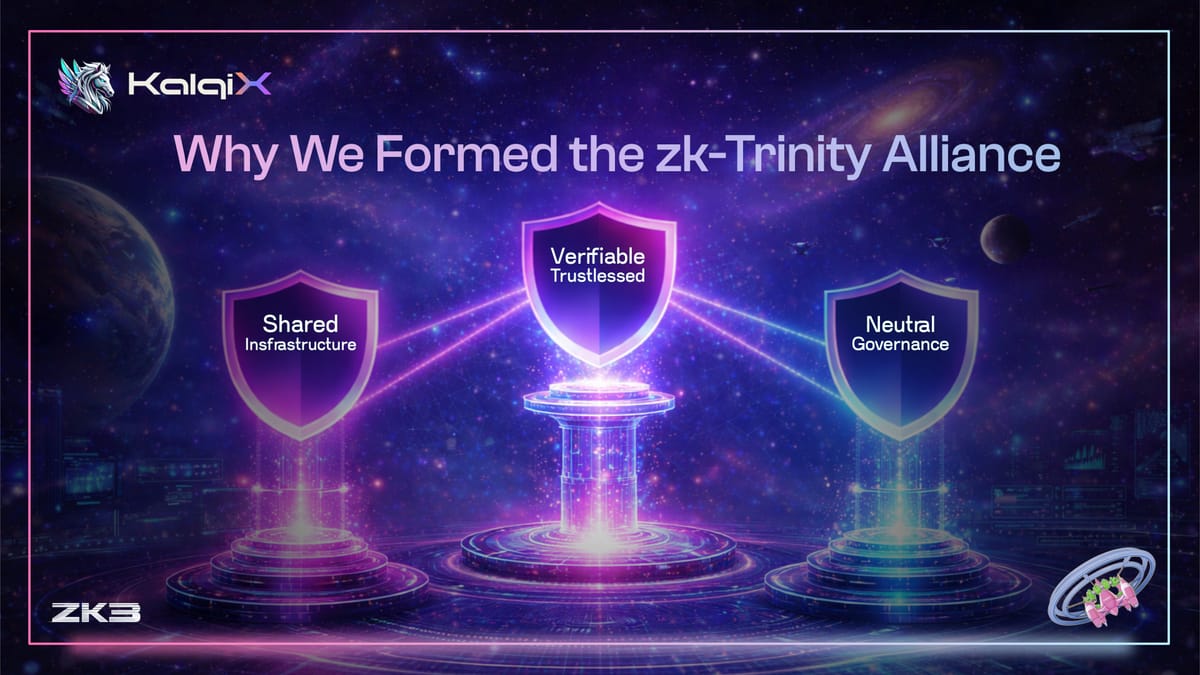
At its core, the alliance is built on three principles:
- Infrastructure Should Be Shared
Execution logic, proof systems, and market primitives should not be locked behind proprietary silos.
Shared infrastructure leads to:
• Better interoperability
• Faster innovation
• Stronger network effects
- Trust Should Be Minimized, Not Rebranded
Replacing “trust us” with “trust our DAO” is not progress.
ZK-3 is built around verifiable execution, where:
• Matching rules can be proven
• Custody is eliminated
• Fairness is cryptographic
The alliance exists to preserve that standard.
- Competition Should Happen at the Edge
Frontends, UX, asset selection, and communities should compete.
Execution integrity should not.
By separating infrastructure from interface, the ecosystem can grow without compromising trust.
What the Alliance Is (and Is Not)
The ZK Trinity Alliance is:
• A coordination layer for zk-exchange infrastructure
• A shared standard for verifiable execution
• A home for builders who care about market integrity
It is not:
• A replacement for KalqiX
• A governance experiment for speculation
• A marketing wrapper around software
KalqiX remains the flagship implementation of ZK-3.
The alliance ensures ZK-3 remains neutral, extensible, and future-proof.
Why This Matters Long Term
The next generation of financial markets will demand:
• Proof over promises
• Verification over reputation
• Infrastructure that regulators can reason about
• Markets that don’t depend on operator honesty
No single company should own that future.
The ZK Trinity Alliance exists to make sure the foundation of verifiable markets is:
• Shared
• Resilient
• And bigger than any one product
From One Exchange to a Global Standard
KalqiX is where ZK-3 proves itself in production.
The ZK Trinity Alliance is how ZK-3 scales beyond a single exchange.
This is not about abandoning ownership — it’s about responsible stewardship.
Infrastructure should be shared.
Trust should not.
That belief is why we formed the ZK Trinity Alliance.